Writing with AI
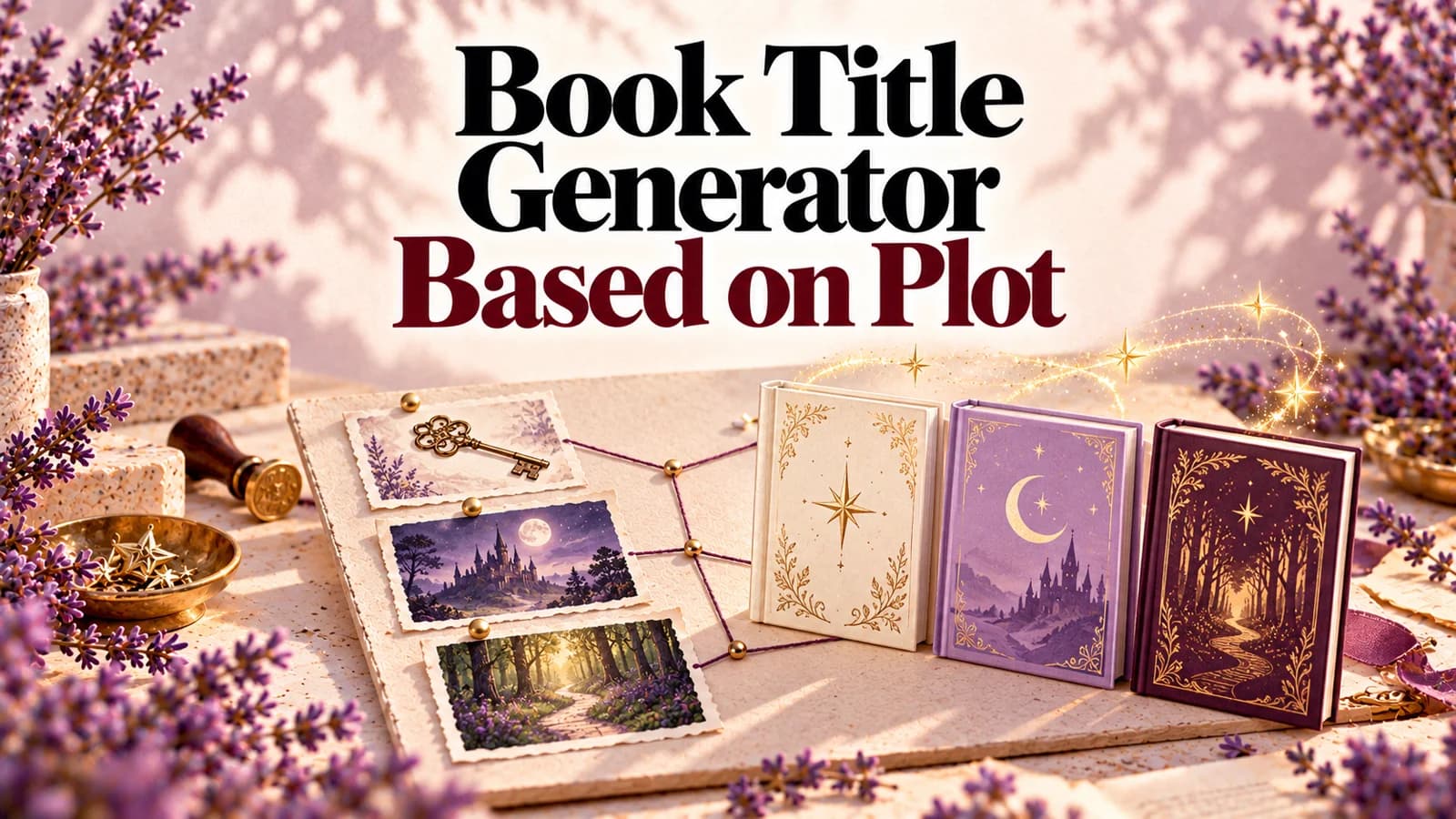
Book Title Generator Based on Plot: How to Find a Title That Fits Your Story (2026)

Romance novelist writing cozy, small-town love stories from a bookshop café in Asheville.
TL;DR: Most book title generators do not read your plot. They take a genre and a couple of keywords and shuffle words like Shadow, Crown, Whisper and Bones into something that sounds like a title but could belong to a thousand other books. A book title generator based on plot works the other way round: it starts from what actually happens in your story (who wants what, what stands in the way, what is at stake, what the book is about) and suggests titles that only your book could carry. This guide explains what makes a title fit a story, a 7-step method for titling your book from its plot, how the main kinds of title generator compare, and how StoryWith AI suggests titles at three points in your book's life: from your raw ideas, from your premise, and from a synopsis of your whole manuscript. Free plan with unlimited books, paid from $19/mo.
Disclosure: StoryWith AI is our own product. We have tried to be fair to the other options and clear about when they are the better fit.
Why most book title generators give you generic titles
Type "fantasy" into a typical title generator and you will get The Shadow of the Forgotten Crown, Whispers of the Ember Throne and A Court of Ash and Starlight. They sound like titles. That is the problem: they sound like every title.
There are three reasons for this:
- They do not know your story. A word-list generator combines nouns and adjectives that are common in a genre. It has no idea that your heroine is a bankrupt lighthouse keeper or that the twist hinges on a forged will.
- They optimise for genre, not for the book. Genre signals matter (a reader should be able to guess the shelf from the title), but a title made only of genre signals is forgettable and often already taken.
- They invent when they have nothing to go on. Even AI generators, given a one-line prompt, fill the gap with confident, generic, "genre-flavoured" phrases. The output looks polished and says nothing about your book.
A title generator based on plot fixes all three by giving the generator something real to anchor on: your premise, your characters, your conflict, and ideally the shape of the whole story.
What makes a title fit a story
Before you generate anything, it helps to know what a good title does. A title that fits its story usually does at least three of these six jobs:
| Job | What it means | Example of the type |
|---|---|---|
| Signals the genre | A reader can guess the shelf | A thriller title that feels tense and clipped |
| Points to the central conflict | It hints at the problem the book is about | A title naming the thing everyone is fighting over |
| Names something specific | A place, object, character or phrase only this book has | A title built on an object that matters in the plot |
| Carries the theme | It means more once you have finished the book | A phrase that changes meaning at the climax |
| Sets the tone | Funny, dark, lyrical, cosy, epic | A light, wry title for a comic novel |
| Is easy to say and search | Short enough to remember, distinct enough to find | Two to five words, no clash with a bestseller |
The best titles come from inside the story. They are often a line of dialogue, an object, a place, or an image that recurs. That is why a title generator needs your plot: the raw material for a great title is already in your book.
A 7-step method to title your book from its plot
You can do this with a notebook, with any AI tool, or with StoryWith AI. The method is the same.
1. Write a one-sentence premise
Who is the main character, what do they want, what stands in the way, and what happens if they fail? For example: "A disgraced lighthouse keeper must prove her missing brother is alive before the island council sells the lighthouse that holds his last message." If you cannot write this sentence yet, no generator will title your book well. Start here.
2. List the specific nouns
Write down the places, objects, names, phrases and images that only your book has. The lighthouse. The last message. The island. The council's vote. These are your best title material, far better than generic genre words.
3. Name the central conflict and the stakes
What is the fight about, and what is lost if the protagonist fails? Titles that hint at the conflict (the vote, the message, the debt) make readers ask a question, and a question is what makes them pick the book up.
4. Name the theme in a word or two
Grief, loyalty, belonging, revenge, second chances. You will not usually put the theme in the title directly, but a title that echoes it gains weight by the last page.
5. Generate in four different styles
Do not generate twenty versions of the same idea. Generate across styles so you can compare real alternatives:
- Literal: says plainly what the book is about.
- Lyrical: an image or phrase with emotional weight.
- Mysterious: raises a question the book answers.
- Bold: short, punchy and confident.
6. Test the shortlist
For each candidate, check: Does it signal the right genre? Is it easy to say out loud? Is there already a well-known book with the same title in your genre? Does it still make sense after the ending? Would it look good on a small thumbnail cover?
7. Re-title once the draft is finished
Your working title was chosen before you knew the whole story. By the end of the draft, the book has changed: subplots have grown, a minor image has become a motif, the ending means something new. Run the process again on the finished plot. Many of the best titles are found in revision, not before chapter one.
Types of book title generator
Random and word-list generators
How they work: pick a genre, get words combined from a list. Good for: a burst of inspiration, unblocking a blank page, naming a placeholder file. Limits: they never see your plot, so results are generic and often already in use.
General AI chatbots
How they work: you describe your story in a prompt and ask for titles. Good for: quick ideas if you write a detailed prompt. Limits: the results are only as good as your description, and you have to paste your plot in every time. Given a short prompt, they invent and produce confident but generic titles. They also do not remember your book next time.
Writing apps with a built-in title tool
How they work: the title tool reads the story details you have already stored in the app: premise, genre, tone and, in the best cases, the manuscript itself. Good for: titles that actually fit, because the tool sees the book. Limits: you need to have your book in the app.
How StoryWith AI works as a book title generator based on plot
StoryWith AI is a writing studio for authors. It is not a standalone title widget: it suggests titles from the story you are actually building, at three points in your book's life.
1. Before you write: titles from your raw ideas
When you plan a new novel, you give StoryWith AI your raw ideas: notes, fragments, a "what if". It drafts a fiction plan from them: title options, a premise, a logline, the protagonist's want, need and fear, the antagonist, the central conflict, the stakes, the setting, the tone and the themes. Because the title options are drafted together with the plot, they come from the same material: the conflict, the stakes and the setting. Pick the one you like and it becomes your book's working title.
2. While you write: four titles from your premise
In the Pitch Kit, the Suggest titles button proposes four titles from your book's premise, genre, tone and current working title. The four are deliberately different in feel:
- one literal,
- one lyrical,
- one mysterious,
- one bold.
That gives you a real choice instead of four variations on one idea. Press Regenerate for a new set. When you find one you like, Use this renames your book (StoryWith AI asks you to confirm first, because the title appears everywhere in your project). Your suggestions are saved, so they are still there next time you open the book.
It will not guess. If your premise is too short to anchor on (under about 20 characters, roughly "An [adjective] [noun] who [verb] when [event]"), StoryWith AI refuses and asks for a real premise instead of inventing titles from genre noise. This is the single biggest difference from a word-list generator: no plot, no titles.
3. When the draft is done: titles from your whole plot
This is the real "book title generator based on plot". When your draft passes 5,000 words, the Blurb & Query tool in the Pitch Kit reads a synopsis of your entire manuscript, chapter by chapter and scene by scene, together with your premise, genre and tone. From that, it produces a full set of publishing assets in one pass:
- 4 alternative titles (your current title can stay at the top if it is still the best),
- a one-sentence hook (logline),
- 3 taglines,
- 3 to 5 comparable titles (books yours would sit next to on the shelf),
- a 120 to 180 word back-cover blurb,
- an author bio and a 250 to 350 word query letter.
Because the titles are generated alongside the hook, blurb and comp titles from the same synopsis, they fit how the book is actually pitched, not just its genre. And because it reads what you have written, it picks up the subplots, images and turning points that grew during drafting: exactly the material that makes for a better title in step 7 of the method above.
4. It knows your story, so you do not have to re-explain it
Everything StoryWith AI knows about your book (premise, genre, tone, chapters, scenes, and your story bible of characters, relationships and world) lives in one place. You never paste your plot into a prompt. Change the premise or finish a new act, and the next set of titles reflects it.
5. It is part of a full studio
Titles are one step. The same project gives you a writing editor, a story bible built from your manuscript, a story analyzer, plot hole and continuity checks, AI beta-reader feedback, a manuscript readiness score and the rest of the Pitch Kit, including cover ideas. When you are ready to submit, your title, hook, blurb and query letter are already consistent with each other.
6. Your title, your book
StoryWith AI suggests; you decide. Nothing changes until you choose a title and confirm it. Your manuscript stays private, and the analysis tools do not rewrite your book.
Book title generators compared
| Random / word-list generator | General AI chatbot | StoryWith AI | |
|---|---|---|---|
| Reads your plot | No | Only what you paste in | Yes: premise, plan and whole-manuscript synopsis |
| Different styles per batch | Rarely | If you ask | Always: literal, lyrical, mysterious, bold |
| Refuses to guess with no plot | No | No | Yes |
| Remembers your book | No | No | Yes |
| Re-titles from the finished draft | No | Only if you paste the draft | Yes, via Blurb & Query |
| Hook, blurb, taglines, comp titles in the same pass | No | If you ask, separately | Yes |
| Rename the book in one click | No | No | Yes, with confirmation |
| Price | Free | Free / subscription | Free plan; paid from $19/mo |
When another option is the better fit: if you just want a burst of random words to spark an idea, a free word-list generator is quicker. If you have not started a book and do not want to set one up, a chatbot with a detailed prompt will do. If you want titles that come from the story you have actually written, use a tool that reads it.
How to generate a book title from your plot with StoryWith AI
- Sign up free at storywith.ai and create a book (or import your manuscript from Word or PDF).
- Write or check your premise. One clear sentence: who, wants what, against what, at what cost.
- Set the genre and tone.
- Open the Pitch Kit and press Suggest titles to get four titles in four styles.
- Regenerate until you have a shortlist of three to five you like.
- Test the shortlist against the checks in step 6 of the method above.
- When your draft passes 5,000 words, run Blurb & Query to get four new titles drawn from your whole plot, alongside your hook, blurb and comp titles.
- Press Use this on the winner. Your book is renamed everywhere.
Frequently Asked Questions (FAQ)
What is a book title generator based on plot?
A tool that suggests titles from what actually happens in your story (your premise, characters, conflict, stakes and themes) rather than from a genre and a few random keywords.
What is the best book title generator based on plot?
The best one is the one that can read your plot. StoryWith AI suggests titles from your raw ideas, your premise, and a chapter-by-chapter synopsis of your whole manuscript, so the titles fit the book you have written.
Is there a free AI book title generator?
Yes. StoryWith AI's free plan includes unlimited books and a monthly allowance of AI actions, with no card required. Title suggestions use your AI allowance.
Can AI name my book from the plot?
Yes. Give StoryWith AI a real premise, or a draft of at least 5,000 words, and it suggests titles from it. If the premise is too thin, it asks for more instead of inventing generic titles.
Should I choose my title before or after writing?
Both. Choose a working title early so the project has a name, then re-title once the draft is finished. The finished plot almost always contains better title material than your first idea.
How do I know if my book title is already taken?
Search your shortlist on major online bookstores and in your genre. Titles are generally not protected by copyright, but sharing a title with a well-known book in your genre makes yours harder to find.
Can StoryWith AI generate titles for non-fiction books?
StoryWith AI supports non-fiction projects too, with a book proposal tool in the Pitch Kit. The approach to titling is the same: start from the book's core promise rather than random keywords.
The one thing to take away
A title generator can only be as good as what it knows about your book. Word lists know your genre. Chatbots know whatever you paste in. A title generator based on plot knows your story: the conflict, the stakes, the images and the turning points that make your book unlike any other.
StoryWith AI suggests titles from your ideas, your premise and your whole manuscript, in four distinct styles, and refuses to guess when there is nothing to go on. You choose. Your book gets a title that only it could carry.
Find a title that fits your plot, free, at storywith.ai. Unlimited books, import from Word or PDF, no card required.
Related reading: Story Bible App · Is My Book Ready to Query? · Story Analyzer · AI Feedback on My Novel