Feedback & Revision
AI Manuscript Analysis: What It Reads, What It Misses, and Why Authors Use StoryWith AI (2026)

Romance novelist writing cozy, small-town love stories from a bookshop café in Asheville.
A finished draft is the hardest thing in the world to read.
You wrote it, so you can't read it cold. You know the villain's motive, so you can't tell whether it's on the page. You fixed the timeline in chapter twelve, so you've forgotten that chapter four still has the old dates. After the fourth read-through, the words stop being words.
AI manuscript analysis exists for exactly that problem. It reads the whole book at once, with no memory of what you meant, and reports what's actually there.
This guide explains what AI manuscript analysis is, what it checks, where it honestly stops, how to tell a good tool from a chatbot with a file upload, and why we built StoryWith AI the way we did. (StoryWith AI is our product. We'll say what it can't do as clearly as what it can.)
What AI manuscript analysis is
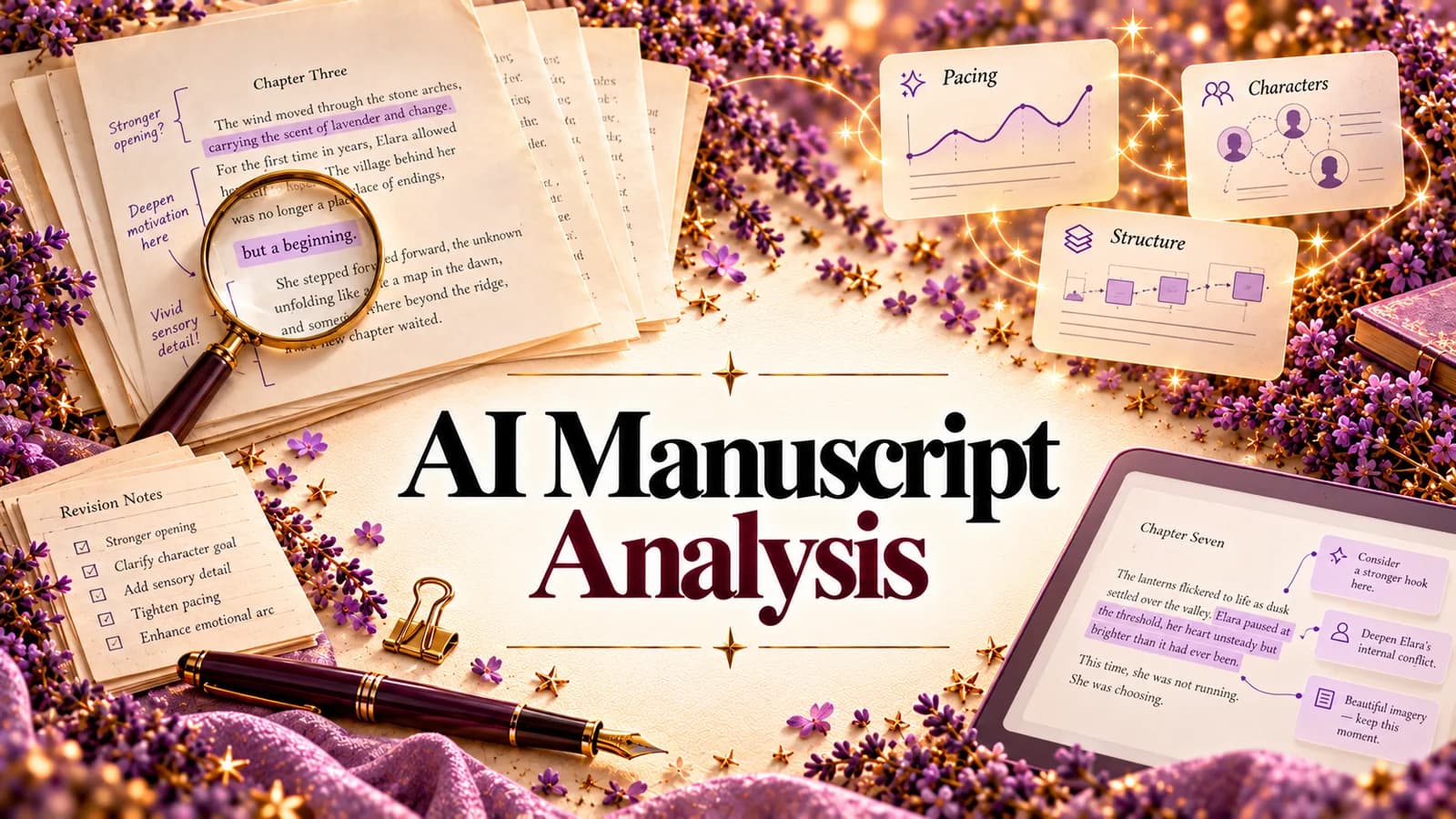
AI manuscript analysis is a diagnosis of the whole book, done by software. You give it your manuscript. It gives you a list of problems: setups that never pay off, a middle that goes flat, a character whose eyes change color, a chapter that leans on an idea you haven't explained yet.
Three things separate it from the AI tools most writers have already tried:
- It reads the book, not the paragraph. A grammar checker sees one sentence. A chatbot sees what fits in its window. Manuscript analysis has to hold chapter one and chapter thirty in view at the same time, because that's where the expensive problems live.
- It produces findings, not prose. The output is a diagnosis. A good tool doesn't rewrite your book. It shows you where to look, and you decide what to change.
- It's a first pass, not a verdict. It catches what can be caught systematically, so a human editor or reader can spend their time on judgment. (For how this compares with a human editor's report, see our guide to editorial analysis.)
What it checks
A useful AI manuscript analysis covers the same ground a developmental editor covers on a first read.
| Area | What it looks for | Why it's hard to see yourself |
|---|---|---|
| Structure | Setups with no payoff, turning points in the wrong place | You know the payoff, so you see it even when it isn't there |
| Pacing | Tension chapter by chapter, long flat stretches | You read your own book too fast to feel the drag |
| Character arcs | Where change starts, stalls or never arrives | Your characters are complete in your head |
| Scene purpose | Scenes that are nicely written but change nothing | Favorite scenes are the hardest to cut |
| Continuity | Names, ages, dates and places that drift | Nobody can remember 90,000 words of detail |
| Dialogue | Voices that blur together, exposition disguised as talk | You hear each character's voice because you invented it |
| Readability | Dense paragraphs, prose outside the genre's range | You know what every sentence means |
| Theme | What the book is about underneath, and where it fades | Theme is easiest to lose in revision |
For non-fiction, the list changes shape. The questions become: does every claim have support, does the argument hold from start to finish, and does any chapter rely on a concept you only explain later?
What it misses
Any AI manuscript analysis that claims to do everything is selling something. Here's where software stops:
- Voice. It can tell you two characters sound alike. It can't tell you whether your narrator's voice is a delight or a slog.
- Market fit. It doesn't know what agents are buying this year, or whether your comp titles are right.
- Whether it moves people. It can chart tension. It can't feel the ending land.
- Deliberate choices. A timeline jump you meant can look identical to one you didn't.
That's not a reason to skip the analysis. It's a reason to run it before a human sees the book. A developmental edit on a 90,000-word novel costs about $2,700–$3,150 at the Editorial Freelancers Association's 2026 rates. Every continuity slip the software catches is one the editor doesn't spend your money on.
Five tests for choosing an AI manuscript analysis tool
Plenty of tools now offer to "analyze your manuscript". Most fall into two camps: report tools that hand you a one-off snapshot, and chat tools where you paste chapters and ask questions. Both can be useful. Neither is the same as a tool built to get a book from draft to ready. Before you upload anything, ask:
- Does it read the whole book at once? Continuity and arc problems only exist across chapters. If the tool works a chunk at a time, it can't see them.
- Is every finding tied to a passage? "Your pacing is uneven" is a horoscope. "Tension drops for chapters 9 to 13" is a finding you can act on.
- Is it ranked? Eight separate reports with no priority is homework, not help. You need to know which three things to fix first.
- Does it stay current while you revise? A PDF report goes out of date the moment you change a scene. The findings should follow your edits.
- Will it leave your words alone? Analysis should diagnose. If the tool quietly rewrites your prose, the book stops being yours.
Add a sixth for anyone with a contract or a query in mind: what happens to your manuscript? It should be private, and it should never be used to train AI models.
Why use StoryWith AI for manuscript analysis
We built StoryWith AI because we kept running into the same gap. The analysis tools gave a report and walked away. The writing tools let you type but never read the book back to you. StoryWith puts the manuscript, the analysis and the readers in one place, and keeps them connected.
1. It reads the whole manuscript, and builds a memory of it
Import a .docx, .md, .txt or .pdf file, or paste the text. StoryWith splits it into chapters and scenes, then builds a Story Bible from what you actually wrote: characters, relationships, places, themes and a timeline. For non-fiction it becomes a Research Bible of the people, concepts and key terms your book depends on.
That bible is what the analysis checks your book against. It's the difference between "this name appears in two spellings" and a tool that only notices when you happen to paste both chapters into the same chat.
You don't need a finished book. The scans work on three chapters as well as thirty.
2. Eight analyzers, one ranked list
The analyzers cover every area in the table above: structure and beats, pacing and emotional arc (on a chart, so flat stretches are easy to spot), character arcs, scene purpose, continuity and plot holes, dialogue, readability and theme. Non-fiction adds fact check, argument soundness and a dependency scan for ideas used before they're introduced.
Then comes the part that matters most. Every analyzer feeds into Diagnostics: one list, with duplicates removed, sorted into Critical, High, Medium and Low. You don't read eight reports. You read one plan, and you start at the top.
3. Every finding points at the page
Each finding links to the scene or section that caused it. In Next Steps it becomes a card that explains why it matters and suggests a direction, the way an editor's letter would. From the card you can open the scene, mark it resolved, pin it, or defer it to the next draft.
Because the list stays current as you revise, fixing a problem removes it. Run the readiness score before you revise and again after, and you can watch the book improve.
4. It never rewrites your book
StoryWith's analysis produces findings, not new text. If you want help with a stubborn passage, you can ask for it: select the text and choose Tighten, Rewrite, Describe, Analyze or Instruct. What comes back is a suggestion, and nothing changes in your manuscript until you accept it.
That matters for two reasons. Your voice stays yours. And feedback on your own book counts as AI-assisted, not AI-generated, under Amazon KDP's guidelines. (Check KDP's current policy before you publish.)
5. It tests the book on readers, not just on software
Analysis tells you what's on the page. Readers tell you how it lands. StoryWith keeps both in the same project:
- AI beta readers. Run a chapter past 3 to 5 simulated reader personas. Each rates engagement, clarity, emotional impact and genre fit, and shows where they'd stop reading. They're simulated and directional, and StoryWith says so.
- Real beta readers. Share chapters with up to 20 readers through a private link. Ask your own questions and see their reactions chapter by chapter. The draft is never sent out as a file.
6. It's private
Your manuscript is visible only to you and the people you invite. It's not used to train AI models, and it's not sold.
A manuscript analysis workflow that works
Here's the order we'd recommend, with or without StoryWith:
- Import the full draft and let the bible build. Skim it. If a character is missing or a place is wrong, that's your first finding.
- Run the whole-book analysis and read only the Critical and High items.
- Fix the structural problems first: setups, arcs, scenes that do no work. There's no point polishing a chapter you're about to cut.
- Then continuity and dialogue, which are fast to fix once the structure is settled.
- Rescore, and test the most-changed chapters on AI readers.
- Send it to humans: beta readers, then an editor, with the mechanical problems already gone.
Most authors never reach the bottom of the Low pile. They don't need to.
What it costs
You can start for free, with no card needed. The Free plan includes every tool and unlimited books, with a small one-time AI allowance and basic continuity and coverage scans.
| Plan | Price | What you get for manuscript analysis |
|---|---|---|
| Free | $0 | Every tool, basic continuity and coverage scans |
| Author | $19/month | 500 AI text actions a month, full continuity, coverage and dependency scans |
| Pro | $39/month | Unlimited AI text actions, priority models, unlimited reader sessions |
| Studio | Team plan | Pro for every member, shared library, pooled AI |
For scale: a book-level analysis of a 90,000-word novel uses about 18 text actions. Check storywith.ai/pricing for current prices.
Common questions
Is AI manuscript analysis accurate? On the mechanical side, such as continuity, structure, scene purpose and readability, it's fast and thorough, and it doesn't get tired on page 300. On judgment calls like voice and market, it isn't the right tool. Treat each finding as a flag to check, not an order to follow.
Can I just paste my manuscript into a chatbot? You can, and you'll get something. But a chatbot forgets earlier chapters, can't rank what it finds, doesn't link findings to passages, and has to start again every time you revise. Manuscript analysis is a different job.
Will StoryWith rewrite my book? No. Analysis produces findings, not text. AI edits only happen when you ask, and only land when you accept them.
Does it replace a human editor? No. It's the first pass that gets the draft ready for one, so their hours go on the questions only a person can answer.
Does it work for non-fiction and memoir? Yes. Non-fiction gets fact check, argument soundness, a dependency scan and a book proposal builder. Memoir gets the same arc, timeline and reader tools as fiction.
Which files can I import? .docx, .md, .txt and .pdf with selectable text. A scanned PDF needs to be saved as .docx first.
The bottom line
AI manuscript analysis won't tell you whether your book is good. It will tell you, in minutes, where the structure sags, where the details drift and which scenes aren't pulling their weight, ranked by how much each one matters. StoryWith AI does that across the whole book, links every finding to the page, keeps the list current as you revise, and never writes a word you didn't choose.
Analyze your manuscript free at storywith.ai.