Feedback & Revision
Character Development with StoryWith AI: How to Build Characters Readers Follow to the Last Page (2026)

Romance novelist writing cozy, small-town love stories from a bookshop café in Asheville.
Readers forgive a slow chapter. They don't forgive a character they've stopped believing in.
Character development is the hardest thing to check in your own draft. You know who your people are. You know what they want, what they're hiding and who they become. The trouble is that some of that lives only in your head, and the reader only gets the page.
This guide explains what character development is, the five ways characters go flat in a real draft, and how StoryWith AI helps you see every character across the whole book: who they are, where they appear, how they sound and whether they change.
Disclosure: StoryWith AI is our own product. We are clear below about what it can't judge for you.
The short version
| Question | Answer |
|---|---|
| What it is | How a character is revealed, tested and changed across a story |
| The core idea | What a character wants (external) versus what they need (internal) |
| Why drafts go wrong | The character on the page drifts from the character in your head |
| StoryWith AI's approach | Profiles built from your manuscript, tracked scene by scene |
| What it checks | Development, presence, arc, voice, relationships and who knows what |
| Your prose | Never rewritten |
What is character development?
Character development is the way a story reveals who someone is, puts them under pressure and lets that pressure change them, or shows why it can't.
It works on two levels at once.
What the reader learns. A name, a face, a job, a way of talking, a fear, a secret. This is characterization: the facts of a person.
What the character becomes. The choices they make when it costs something, and who they are by the end. This is the arc: the change.
A well-developed character is not one with a long backstory. It's one whose choices make sense, cost something and add up to a change the reader can feel.
Want versus need: the engine of every arc
Most writing teachers agree on one tool above all others: the gap between what a character wants and what they need.
- The want is external and conscious. Win the case. Get the girl. Find the killer. Save the farm.
- The need is internal and usually hidden from the character. To trust someone. To forgive themselves. To stop running.
The plot chases the want. The arc delivers the need. The strongest endings make the character choose between them, or discover the want was never the point.
| Arc type | What happens | Example shape |
|---|---|---|
| Positive change | The character lets go of a false belief and gets what they need | The loner who learns to ask for help |
| Negative change | The character clings to the lie and loses | The ambitious hero who trades everything for the want |
| Flat arc | The character already holds the truth and changes the world around them | The steady mentor who tests everyone else |
A flat arc is not a flat character. It's a character who doesn't change because the story is about them changing others. What matters is that the arc is the one you chose.
The five ways characters go flat in a draft
Characters rarely fail in the outline. They fail somewhere in the 300 pages between.
1. They vanish. A key character carries chapters 2 to 6, then disappears until chapter 19. Readers forget why they cared.
2. They stall. The protagonist in chapter 24 is the same person as in chapter 4. Things happened to them. Nothing happened in them.
3. They all sound the same. Cover the speaker tags and you can't tell who's talking. Every character has your voice.
4. They drift. Green eyes in chapter 3, brown in chapter 22. Afraid of water in act one, swimming without comment in act three.
5. They know too much. A character acts on a secret they haven't learned yet. Or a relationship jumps from strangers to confidants with no scene between.
Every one of these is invisible from inside the draft, because you fill the gaps from memory. A reader can't.
And if the real problem is a cast that's simply too big, see Too Many Characters in a Novel.
How StoryWith AI helps you develop your characters
StoryWith AI is a writing studio that reads the manuscript you wrote and shows you what's on the page. It doesn't write your characters for you. It tracks them, so you can see where they're strong and where they need work.
A cast built from your own pages
Import your draft and StoryWith splits it into chapters and scenes, then builds a Story Bible from what you actually wrote: your characters, their relationships, places and a timeline.
Starting from an idea instead? StoryWith can turn a premise into an outline with a starting cast, each with a want and a need, for you to shape.
A full profile for every character
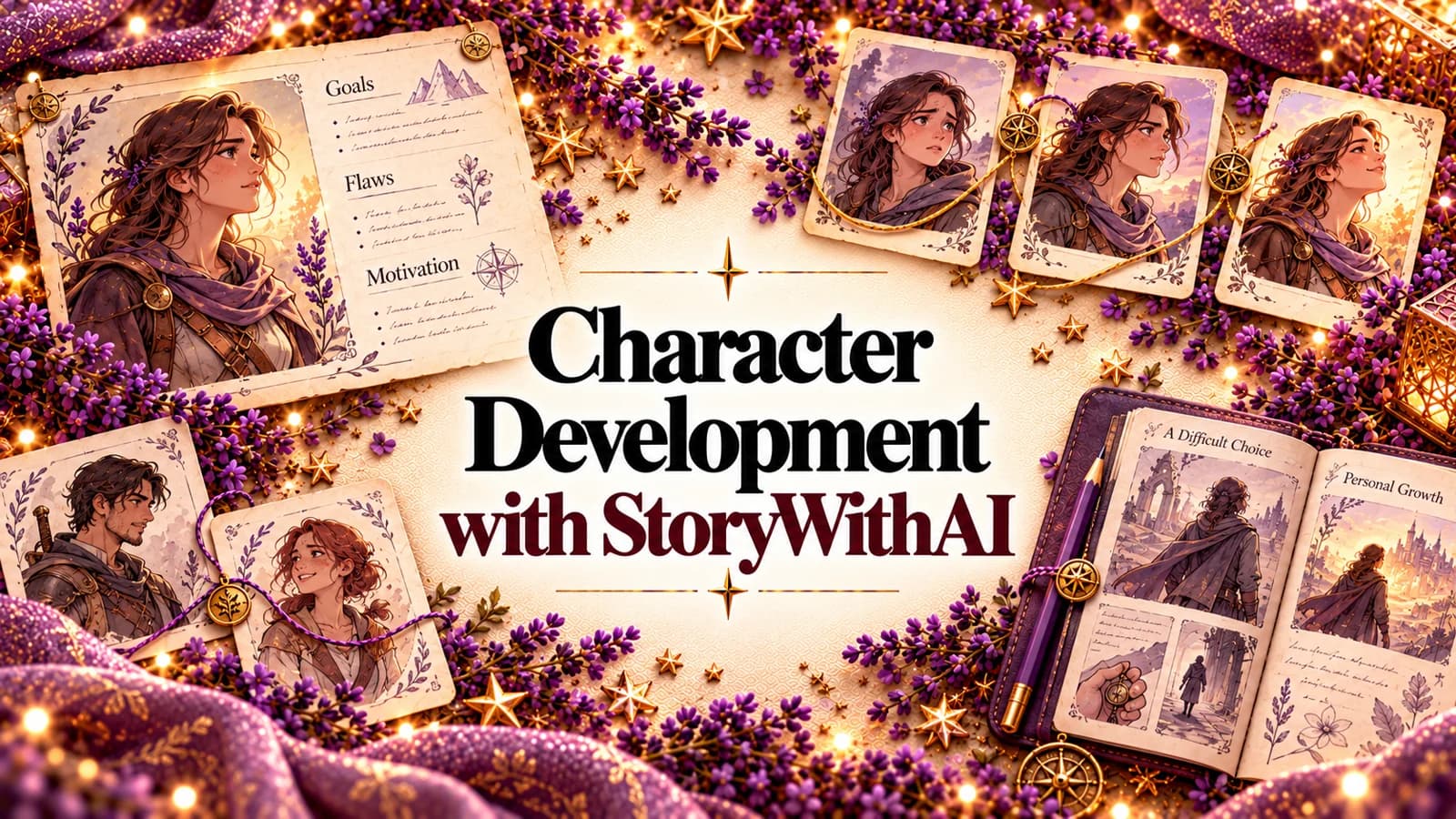
Each character gets a profile with room for everything you need to keep straight:
- Role, age, gender, pronouns and occupation
- A one-line description and a physical description
- Voice and speech patterns
- Goals (what they want), fears and secrets
- Backstory
- Arc: want (external) and Arc: need (internal)
- Aliases and nicknames
Aliases matter more than they look. StoryWith uses them to find every mention of a character, so "Margaret", "Maggie" and "Mrs. Hale" all count as the same person. Each profile then shows how many scenes that character appears in, with a link to each one.
Profiles that keep up with the draft
Character sheets usually go stale by the second draft. You give someone a new backstory in chapter 9 and the notes from three months ago are now wrong.
StoryWith's Sync with manuscript reads the draft again and proposes updates to your characters. You choose which updates to keep, and your manual entries stay untouched. Characters you add while planning but haven't yet written into a scene are marked as drafts, so you can see who's planned and who's on the page.
Rename a character and you can carry the change through the whole book, reviewing each change first.
A development score for every character
On the Timeline, StoryWith shows you, chapter by chapter, which characters are on the page. Press Analyze development and it rates each character as:
| Rating | What it means |
|---|---|
| Underdeveloped | The reader knows too little to care |
| Emerging | The shape is there, but thin |
| Developed | A full, believable person on the page |
| Rich | Depth, contradiction and change |
For each character you get what the reader knows so far, the gaps and suggestions for what to add. It also marks each character's first appearance, and flags when a key character is missing from a chapter. That's problem one, the vanishing character, caught for you.
Character arcs, checked against the book you wrote
Your profile says what the arc should be. StoryWith's character arc analysis checks whether the draft actually delivers it: where change starts, where it stalls and where it never arrives.
That's problem two, the stalled arc. You set the want and the need. StoryWith tells you whether the pages earn them.
A character's arc and the book's tension curve are two different things. For the tension curve, scene by scene, see Emotional Arc Visualization.
Every scene is also tagged by purpose. A character scene is one whose job is to develop someone: growth, change, or a choice that reveals who they are. If you can't find many character scenes for your protagonist, that's worth knowing before a reader finds it for you.
Voices that don't collide
Dialogue Intelligence reads your dialogue line by line and scores each scene for voice distinctiveness, pacing rhythm and subtext. It lists every speaker with their line count and average line length, and flags:
- Voice collisions: two characters who sound too alike
- On-the-nose lines: characters saying exactly what they feel, with no subtext
That's problem three. You still write the lines. StoryWith shows you where two people have merged into one.
Continuity: the eyes, the scars and the secrets
The continuity checker catches characters who drift: the eye color that changes, the injury that heals too fast. That's problem four.
For problem five, you can name a secret in your story and track which characters know it. If someone acts on a secret before they learn it, you'll see it.
Relationships you can see
The Character Graph maps your cast as a network and shows how relationships shift across the manuscript. You can add relationships by hand or let them come from the draft. A friendship that turns to rivalry, or an alliance that forms too fast, is easier to judge when you can see it.
Will readers care about these people?
Two ways to test it before you publish:
- Reader personas. Run a scene or chapter past a panel of simulated reader types with the goal set to character engagement: do readers care about the people? You see where the personas agree and where they split.
- Real readers. Share chapters with up to 20 beta readers through a private link and see exactly where each one stopped reading.
If readers drop off in the chapters where your protagonist goes missing, you know the problem is real.
Why use StoryWith AI for character development
It reads the book, not your notes
A character template asks what you intend. StoryWith reads what you wrote. The gap between those two is usually where the problem is.
It covers the whole manuscript
Pasting chapters into an AI chat gets you an opinion on a few pages. StoryWith tracks every character across every scene.
Every finding links to the page
Character findings go into one ranked list of what to fix first, alongside pacing, continuity and structure. Click any item and you're at the scene.
It never writes your characters for you
StoryWith shows you where a character is thin. It doesn't fill them in by rewriting your prose. Every sentence stays yours. Because StoryWith diagnoses rather than writes, its feedback counts as AI-assisted under Amazon KDP's guidelines. (Check KDP's current policy before you publish.)
Your manuscript is private by default, is never used to train AI models, and is never sold.
Character development tools compared
| Character template | Spreadsheet | AI chat | StoryWith AI | |
|---|---|---|---|---|
| Built from your manuscript | No | No | Only what you paste | Yes |
| Stays in sync with the draft | No | Only if you update it | No | Yes, you review each update |
| Shows where each character appears | No | By hand | No | Yes, scene by scene |
| Flags missing key characters | No | No | No | Yes, per chapter |
| Rates development | No | No | Sometimes | Yes, with gaps and suggestions |
| Checks the arc against the draft | No | No | Rarely | Yes |
| Finds voice collisions | No | No | Sometimes | Yes |
| Tracks who knows which secret | No | By hand | No | Yes |
| Tests on real readers | No | No | No | Yes |
| Rewrites your prose | No | No | Often offers to | Never |
A template is useful before you start. Once there's a draft, you need to see what's on the page.
How to develop your characters, step by step
- Import the whole draft. StoryWith builds your cast from the manuscript.
- Open Characters. Fill in the gaps: want, need, fear, secret and voice. Add aliases.
- Open the Timeline. Check where each key character appears and where they vanish.
- Run Analyze development. Start with any character marked Underdeveloped or Emerging.
- Check the arcs. Does the protagonist change? Is the change earned on the page?
- Run Dialogue Intelligence on your busiest scenes. Fix the voice collisions first.
- Run continuity. Catch the drift and the secrets known too early.
- Revise in your own words, then sync and re-analyze.
- Test it on readers. Use personas for a quick check, beta readers for the real one.
What StoryWith AI can't tell you
- Whether a character is likable. It can tell you a character is thin. It can't tell you whether readers will love them. Unlikable can be the point.
- Whether a quiet character is a mistake. Some of the best characters say little. A low dialogue count isn't a flaw on its own.
- Your intentions. A character who never changes may be a flat arc by design. The analysis asks you to check. It doesn't say you're wrong.
- Perfect accuracy. Development ratings and arc findings are AI estimates. Use them to find where to look, and trust your judgment about what you find.
What it costs
You can start free, with no card needed. The Free plan includes every tool and unlimited books, with a small one-time AI allowance.
| Plan | Price | Who it's for |
|---|---|---|
| Free | $0 | Trying the whole process on your own book |
| Author | $19/month | Working authors: 500 AI text actions a month, full continuity, coverage and dependency scans |
| Pro | $39/month | Full-time authors and editors: unlimited AI text actions, priority models, unlimited reader sessions |
| Studio | Team plan | Teams: shared library, roles, pooled AI |
Check storywith.ai/pricing for current prices.
Common questions
What is character development in writing? How a story reveals who a character is, tests them under pressure and changes them, or shows why they can't change.
What's the difference between a character's want and need? The want is the external goal the character chases. The need is the internal change they must make. Strong arcs put the two in conflict.
Can AI develop my characters for me? StoryWith won't write your characters. It shows you where they're thin, where they vanish and where their arc stalls, so you can develop them yourself.
Does StoryWith work with a draft I wrote somewhere else? Yes. Import it and StoryWith builds your cast, relationships and timeline from what you wrote.
Does it work for non-fiction? For non-fiction books, characters become Subjects: the real people in your memoir, biography or history, tracked the same way.
Will it change my character names or notes without asking? No. Sync proposes updates and renames show you each change. You approve them.
The bottom line
Readers don't follow plots. They follow people. If a character vanishes, stalls or starts sounding like everyone else, readers drift away, and they rarely tell you why.
StoryWith AI builds your cast from the pages you wrote, keeps every profile in step with the draft, rates how developed each character is, checks whether the arc lands, finds the voices that collide and the secrets known too early, and links every finding to the page. You develop the characters. It shows you where.
New to StoryWith? Start with Book Writing with StoryWith AI, a step-by-step guide from first idea to finished manuscript.
Build your cast free at storywith.ai.