Writing with AI
Writing Books: What Actually Happens Between the Idea and the Finished Draft

Memoirist and former hospice chaplain writing about grief, memory, and finding meaning late.
TL;DR — Writing books is not one skill, it is five, and almost all the advice online is about the first one. Getting words down is the stage writers eventually solve on their own. Books die in stage four — the finished-but-broken draft that no longer makes sense to the person who wrote it — because nobody owns a tool for that stage, and a human developmental editor costs four figures and six weeks. StoryWith AI is built for exactly that gap: it reads the whole manuscript, names the structural problems, ranks them into one queue of next moves, and tests the result on readers. Free plan with unlimited books, paid from $19/mo, ten languages.
The honest version of what writing books involves
Ask ten people what writing books is and you will get ten answers about the writing. Word counts. Morning routines. Whether you outline or discover. The romance of the thing is all located in the drafting, which is why every article about it is about the drafting.
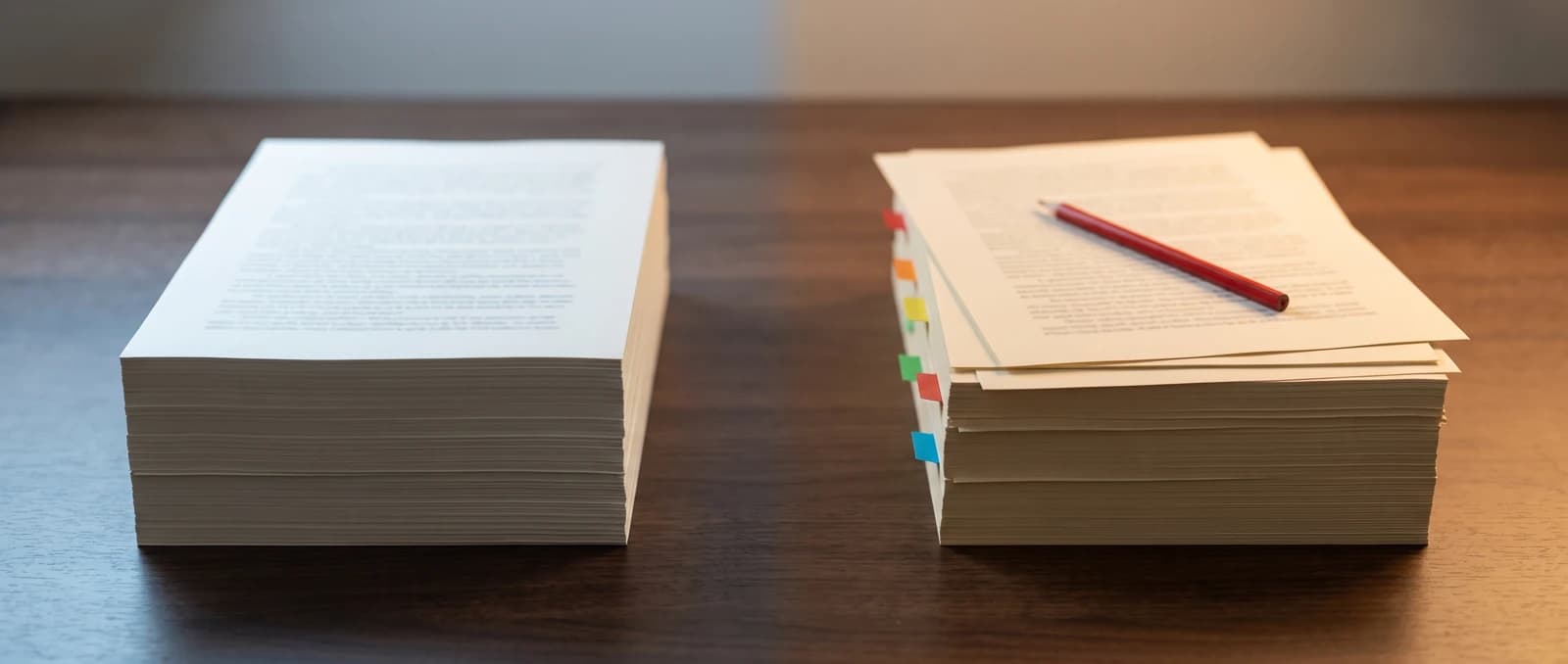
But talk to anyone who has finished two or three books and the story changes completely. They will tell you the drafting was the part they knew how to do. The part that nearly killed each book was the six months after the draft existed — when the manuscript was complete, technically, and also quietly wrong in ways they could feel but not name.
That gap between what people think writing books involves and what it actually involves is the reason so many first drafts become last drafts. So here is the whole process, in five stages, with an honest account of what each one demands and where it breaks.
Stage 1: The idea — cheaper than everyone thinks
The most over-protected asset in writing books is the idea, and it is worth the least.
Every published author has a drawer of ideas they will never use. Ideas are free and endlessly renewable; execution is scarce. The writer guarding a premise for three years is usually not protecting it from theft — they are protecting themselves from finding out whether they can execute it.
What an idea actually needs, before it is worth a year of your life, is a single sentence that contains a tension. Not "a book about grief." A woman inherits her estranged mother's restaurant and the staff who knew her better than she did. Something is already pulling against something. If your idea cannot produce that sentence, the difficulty you will hit in month seven is already baked in.
Where it breaks: almost nowhere. People do not fail at writing books because the idea was weak. They fail later, and blame the idea retrospectively.
Stage 2: The first draft — a volume problem, not a talent problem
This is the stage everyone means when they talk about writing books, and it is fundamentally an arithmetic problem.
A commercial novel runs 80,000 to 100,000 words. At 500 words a day — twenty focused minutes for most people — that is roughly six to seven months. Not six to seven months of inspiration. Six to seven months of turning up on Tuesday when you do not feel like it.
Three things matter here and nothing else does:
- A fixed, small, genuinely achievable daily target. 500 beats 2,000, because 500 survives a bad week.
- Stopping mid-scene. Ending the session with a known next sentence removes the cold-start cost that makes tomorrow's session the one you skip.
- Not editing backwards. Rereading chapter one for the eleventh time feels like work and produces nothing. The first draft's only job is to exist.
Where it breaks: the middle. Roughly 30,000 to 50,000 words in, the opening excitement is spent and the ending is not close enough to pull. Most abandoned manuscripts die here, and the cause is almost always the same — the writer stopped to fix something they could not yet see clearly, and the momentum never came back.
The fix is unglamorous and it works: finish the bad draft. A complete bad draft can be diagnosed and repaired. An immaculate half-draft cannot, because the shape it needs is not there yet to judge.
Stage 3: The gap — when the draft exists and you cannot read it
You finish. You expect relief. What arrives instead, usually within a week, is a very particular kind of unease.
You open the file on a Sunday, read chapter fourteen, and something is wrong. Not wrong in a way you can point at — just a flatness, a sense the book drifted from the thing it was supposed to be. You scroll up to check a detail in chapter four, lose forty minutes, and close the laptop having changed nothing.
This is the single most under-described experience in writing books, and it has a cause that is not a character flaw. You cannot read your own manuscript. You have read those 90,000 words maybe thirty times, in fragments, out of order, at the speed of composition. Your brain no longer processes the text — it retrieves the intention behind the text. When you read chapter two, you see what you meant. A reader sees only what is on the page.
Which is why the three questions you now need answered are the three you are structurally unable to answer yourself:
- What is actually broken, in nameable terms?
- Of everything broken, what matters most?
- Will a real reader like it?
Stage 4: Revision — where books actually die
Stage four is the one nobody warns you about, and it is where the majority of complete manuscripts go quiet forever.
The traditional answer is a developmental editor: a professional who reads the whole book and tells you what is structurally wrong. It works. It is also four figures for an 80,000-word novel, roughly six weeks of waiting, and you get exactly one pass. Revise afterwards and you are back to guessing, because nobody is reading the new version.
So most people writing books outside a publishing deal try the free substitutes, and each one fails in a predictable way.
| What people try at stage four | Why it fails |
|---|---|
| Friends and family | Kind, unspecific, socially incapable of saying the middle drags |
| Beta reader groups | Real feedback, 60% no-show rate, six-week turnarounds, reciprocal obligations |
| Grammar and style software | Sentence-level by design — a perfectly polished dead scene stays dead |
| General AI chat assistants | Reads a slice of the book, not the book; confidently answers about the slice |
| Rereading it yourself again | You retrieve intention, not text — the exact problem you are trying to escape |
| A developmental editor | Genuinely works. Four figures, six weeks, one pass |
Notice the shape of that table. Everything affordable is either too shallow or too unreliable, and the only thing that actually does the job is priced for people with a publisher. That is the gap where books die — not from lack of talent, and not at page one, but in the silence after a finished draft when there is nobody to ask is this working, and if not, what do I fix first?
How StoryWith AI closes the stage-four gap
StoryWith AI is a manuscript-aware story studio, and it exists specifically for the stage that has no tool. Three things distinguish it from everything in the table above.
It holds the whole book, not a window
Every general assistant works inside a context window, and your book does not fit through it. So it sees a slice, answers confidently about the slice, and is architecturally incapable of noticing that chapter nine contradicts chapter two. You cannot prompt your way past that.
StoryWith AI ingests the entire manuscript as a project — chapters, scenes, characters, timeline, themes, and the promises the book has made to its reader. Import a 90,000-word .docx, PDF or plain text file and it is analysed in minutes. When it tells you a setup is unpaid, it means unpaid in the book.
It finds nameable problems, anchored to scenes
Not "your middle drags." Specific, locatable findings:
- Continuity contradictions — eye colour that changes between chapters, a wound that heals three chapters early, the Tuesday that happens twice. Each sentence is individually plausible, which is exactly why nobody catches them locally.
- Unpaid setups — the letter in chapter two, the phone call, the scar. Readers log every one as a promise and feel it when the book never pays it back. You cannot see your own, because in your head the payoff exists.
- Scenes that do not earn their place — beautifully written and structurally inert: nothing changes, no pressure rises, no decision is forced. Cutting these is the largest single quality gain available to most drafts.
- Pacing dips — the stretch where readers put the book down "just for tonight." You can feel one while writing but you cannot locate it.
- Flat dialogue — lines that transfer information and do nothing else. The most common invisible weakness in competent manuscripts.
- Stalled character arcs — the protagonist who is recognisably the same person in chapter twenty-four as in chapter four.
Every finding links back to the exact scene it came from, which is the difference between feedback you can act on and feedback you resent.
It ranks the findings into one queue
Run a full pass on a novel and you can clear a hundred findings. A hundred findings is not help — it is a wall, and walls make people close laptops. It is the same reason expensive developmental edit reports so often sit unopened: four pages of accurate criticism, and the author quietly puts it away.
So StoryWith AI does not hand you a report. Everything feeds one ranked queue — the Action Engine — scored on severity (how much damage it does), confidence (real problem or stylistic choice) and effort (what the fix actually costs). What comes out is your single best next move, at the top. Fix it, mark it done, take the next one.
That converts an overwhelming mountain into a sequence of forty-minute tasks, and forty minutes is what most people writing books around a job actually have.
It tests on readers before you publish
Once the structure holds, the remaining question is whether anyone will like it. AI reader personas respond as a defined reader type would — a thriller reader who wants pressure on every page reacts very differently to chapter eleven than a literary reader who came for interiority, and seeing where they diverge tells you who your book is for. Real beta readers get a private link with no signup required, which is the whole reason beta reads actually happen; friction, not goodwill, is what kills them. Then the system calibrates what the personas predicted against what the humans said, so its read of your book gets more accurate over time.
It does not write the book
There is no button that drafts chapter nineteen while you make tea. Generation exists for when you are stuck at a wall, but it is optional and writer-controlled, and the sentences stay yours. Two reasons that matters: readers cannot articulate what makes a writer feel like that writer but they feel its absence instantly, and platform disclosure rules are tightening around AI-generated work in a way that never touches AI-assisted analysis of your own writing.
Fiction and non-fiction are both first-class — the non-fiction analysers look at argument structure, evidence density and whether each chapter advances the thesis or restates it — and it works in ten languages.
Stage 5: Finishing — and what a working process looks like
The last stage is the shortest and the most mechanical: a copyedit for sentences, then formatting for print and ebook. It only goes badly when it arrives too early, with a structurally unsound manuscript. A copyeditor cannot fix a third act, and paying one to discover that is an expensive way to learn.
Put together, a process for writing books that actually terminates looks like this:
- Bring what you have — one sentence, an outline, or a finished draft. All three are valid starting points, and if you are importing, do it before you tidy anything; the mess is the data.
- Get the spine visible — chapters, scenes, characters, timeline. Importers often see the real shape of their book for the first time here, rather than the shape in their head.
- Write — in StoryWith AI, Word, Scrivener or a notebook. It genuinely does not matter, and the tool is not trying to own your drafting hours.
- Analyse a complete draft. Not a half-draft. Structural analysis of an unfinished manuscript is noise.
- Work the queue top down. Most authors find the first ten items fix about half of what was bothering them.
- Test on readers — personas first, then humans on a private link.
- Calibrate, then finish — hand a structurally sound manuscript to a copyeditor who can now spend their time on sentences.
Pricing, and who this is not for
The free plan gives you unlimited books, manuscript import from Word, PDF or plain text, basic scans and a monthly allowance of AI actions. The metering is on compute, because that is what costs real money — not on your projects, so you can run an actual manuscript through it rather than a toy one. Paid plans start at $19/mo, against four figures and six weeks for a single developmental pass.
Three people should not bother. If you want the AI to produce the words, this is the wrong product and Sudowrite is the right one. If you write marketing content rather than books, a manuscript analyser offers you nothing. And if your draft is half-finished, come back when the messy complete draft exists — that is the day this is worth ten times its price.
The one thing to take from this
Writing books is five stages, and the entire industry is built around stage two. Stage two is the one writers eventually solve on their own, because you can always write something.
Nobody built for stage four — the draft that exists and no longer makes sense to the person who wrote it. That is where books stop, and it is the only stage where the right tool changes the outcome rather than the experience.
Start free at storywith.ai — unlimited books, import from Word or PDF, no card required.